Egg freezing has become an important option for women looking to preserve fertility, but the process can raise many questions. How effective is the egg freezing process? What are the risks and timing considerations?
With new options and innovations emerging, including AI-driven tools, it’s more important than ever to have clear, practical guidance on what the procedure involves and how technology can support informed, confident decisions.
The egg freezing process: What to expect
Egg freezing, or oocyte cryopreservation, is a multi-step medical process. The journey typically takes about two to three weeks. While every clinic has its own approach, the core steps include:
Initial assessment: You meet with a fertility specialist, review your medical history and undergo bloodwork and tests to measure your ovarian reserve.
Ovarian reserve refers to the number of eggs you have remaining in your ovaries and the tests can include an antral follicle count (AFC) or a blood test called an Anti-Mullerian Hormone (AMH) level, which are helpful in comparing an individual’s relative egg number to what would be typically expected for their age.
Ovarian stimulation: For 8–12 days, you take hormone injections that encourage your ovaries to mature multiple eggs at once.
Monitoring: You’ll have several ultrasounds and blood tests to track how your follicles are growing.
Egg retrieval: The retrieval itself is a quick, minimally invasive procedure performed under light sedation. A doctor uses ultrasound guidance to collect the eggs from your ovaries.
Freezing: After the retrieval, an embryologist identifies the mature eggs and prepares them for vitrification—a "flash-freezing" method that prevents ice crystals from forming, keeping the eggs stable for years.
Why age and quantity aren't everything
For years, the "success" of an egg freezing cycle was estimated using a simple calculator: "At age X, with Y number of eggs, you have a Z% chance of a live birth."
While helpful, this approach is based on population averages. It assumes that every 35-year-old has the same egg quality. In reality, egg quality varies significantly from person to personand even from egg to egg within the same retrieval. Two women of the same age might both freeze 15 eggs, but one woman’s eggs may have a much higher biological potential. Until recently, there was no way to "see" that quality before the eggs were thawed and fertilized years later.
How AI offers a personalized view
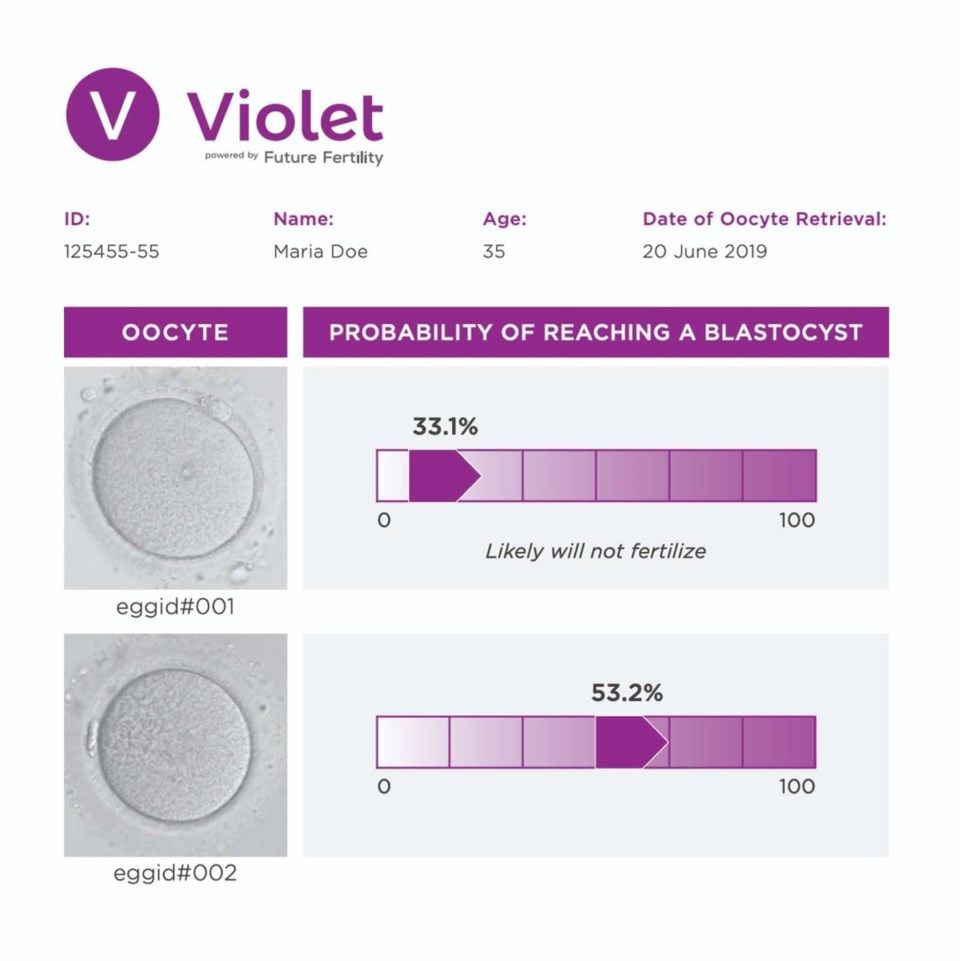
New AI-based technologies, such as VIOLET™ from Future Fertility, are designed to add another layer of insight. These tools analyze images of your eggs and compare them to large datasets of eggs with known outcomes. By identifying subtle patterns that embryologists can’t see with the naked eye, the software generates predictions such as:
- The likelihood that each egg will develop into a blastocyst.
- A personalized estimate of your overall chance of a future live birth
This approach doesn’t replace medical expertise and it doesn’t guarantee outcomes. But it does offer individualized information based on your actual eggs — not just your age group. That’s a meaningful shift.
Check out the image from a sample Violet report: